
Report: Barehands Residency in Malaysia 2024
In the summer of 2024, I participated in the "Barehands Residency" artist-in-residence program in Malaysia, spending a month creating new work. Each day was filled with inspiration. Through total immersion in my practice and meaningful exchanges with local artists and organizers, I truly felt myself growing as an artist.
Upon returning home, I compiled a photo book titled "Light of Langsuir -A New Myth-" to document this residency. In this post, I’ll be sharing a selection of its contents. I hope it serves as a helpful resource for anyone interested in traveling to Malaysia or participating in an artist residency.
Light of Langsuir: A New Myth
01 Before Departure: Shifting Plans
My residency in Malaysia was a series of challenges that tested my flexibility. Many situations arose where the ways I was accustomed to working in Japan simply did not apply, making the experience a true encounter with the unknown.
Although I had decided to participate in the project a year earlier, I was unable to receive detailed information from the host artist, Juhari, regarding the schedule, accommodation, or travel arrangements, and as the departure date neared, my anxiety grew. Eventually, the manager, Nazura, became involved and negotiations progressed quickly, but the funding source was not decided until two months before departure, and the possibility of covering the entire cost myself loomed. Juhari’s optimistic remark, “As long as you book the flight, everything will work out!” only heightened my internal unease.
Amidst this, thanks to Juhari’s efforts, the Japan Foundation, Kuala Lumpur decided to offer full support. I was finally able to relax. I later learned that the support had been confirmed from the beginning, but the information had not been conveyed to Juhari and the team. Hearing this made me think, “If only I had known earlier!” but looking back now, it’s almost a funny story.


02 Language Barrier: Frustration
When I arrived, the language barrier turned out to be less of a problem than I had feared. The English conversation classes I had started taking six months earlier unexpectedly paid off, and I managed to participate in a local radio show and a talk session at the National Art Gallery Langkawi. However, I was often impressed by the bilingual fluency of local art professionals who seamlessly switched between Malay and English, and I felt keenly aware of my own limitations. I often regretted not being able to engage in deeper discussions about religion and culture, wondering how much more enriching the exchanges could have been had I been more fluent.


03 Life in Malaysia: Prayer and Nature
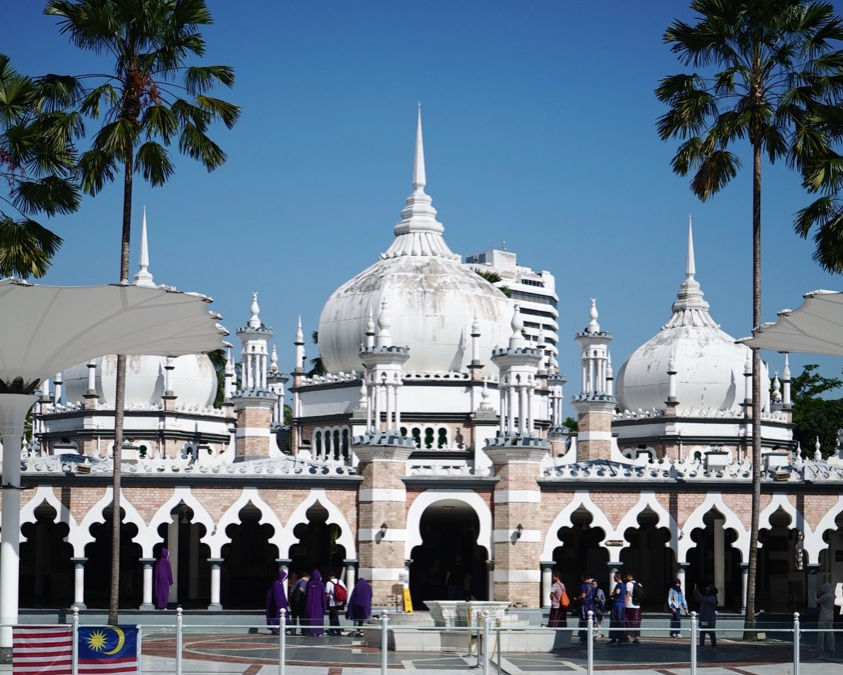
In Malaysia, Islam is at the core of daily life. Every morning around 5 a.m., the sound of the call to prayer echoes from the mosque, and the still, dimly lit surroundings of the studio are enveloped in a sacred atmosphere. The scene was mystical, with a beauty that brought a sense of calm amidst the silence.
The Muslims, who live disciplined lives without alcohol and pray five times a day, made me feel strongly that humans and nature coexist in harmony. The morning and evening are surprisingly cool, and the scorching heat of the day is reset by sudden thunderstorms. This natural cycle, which feels like the flow of life itself, made me deeply appreciate the connection between humans and nature.

04 Inspiration: Malaysian Mythology
During my stay, the creation of my work began with choosing the Paku Langsuir (also known as the giant fern or “Ootaniwatari” in Japan), which grew abundantly in Juhari’s studio garden. In Malaysian mythology, the Paku Langsuir is a sinister plant symbolizing the female ghost “Langsuir.” The ghost of a woman who died during pregnancy or childbirth is said to be linked to this plant, and the story is quite chilling. Many elderly Malaysians avoid planting such a “bad omen” in their gardens, but Juhari laughed and said, “I plant it because I think it’s beautiful. That’s all.” Drawn to this simplicity, I decided to use the plant as the material for my work.
The title of the exhibition is “Light of Langsuir.” It’s an attempt to shed light on the tragic mythology of Langsuir and create a new myth. I decided to capture the “light” of the jungle through photography and use it to overlay the images onto the leaves.


05 Creation: Purification of the Material
The process of creating the work began with coating the large leaves of the Paku Langsuir with white acrylic paint. I meticulously painted both sides to enhance the vibrancy of the photographs I would later apply, but for me, it was also an act of “resetting the material’s story and making it an empty vessel.” The dark green color of this tropical plant is considered to have an “ominous” side in mythology. However, by painting it white, like a ritual purification, I was able to remove the negative imagery and create an “empty space” where new meanings could be received.
The work itself was simple, and as I repeated the process, I naturally became absorbed in it. As the leaves gradually transformed into a clean, white state, I felt a sense of personal purification as well. When the leaves lost their texture and became wrapped in the pure white, I felt as if the “vessel to receive new myths” had truly emerged.

06 Photographs of Light: The Energy of the Place
I printed the photographs of the light in the surrounding jungle onto washi paper and carefully adhered them to the white leaves. For me, photographs are not just records, but a medium through which the energy and atmosphere of a place are transferred. The reason people cannot easily step on or discard cherished photographs is that they perceive them as more than just material; they hold a deeper significance. This is similar to how icons are viewed as windows to the divine, or how the Jomon people (prehistoric inhabitants of Japan) believed that spirits resided in clay figures. Photography has the ability to make people feel the invisible forces behind shapes.
For this work, I primarily used vivid photographs of tall tropical plants unique to the jungle, the blue sky resonating with the sound of the call to prayer, and the views of orchards. The bright colors of flowers, the ground after rain, and the sunlight filtering through the forest all transformed into soft textures when printed on washi paper, giving them a unique presence on the white-painted leaves. By resetting the plant’s original “Langsuir” story and overlaying it with the “light” of the jungle, I experienced a feeling of purification, as if the tragic ghost was being cleansed.


07 Exhibition: A New Myth
At the National Art Gallery Langkawi’s exhibition space, I created around 20 pieces by suspending the leaves from the ceiling with transparent wires, allowing them to sway gently in the wind. The layout was designed so that the viewers could walk through and “experience” the jungle I had lived in. The leaves floated and reflected the light and colors of the photographs, shimmering in the space. Their movement was like that of a hovering ghost, but it also conveyed a refreshing sense of vitality.
The title “Light of Langsuir” encompasses the intention of “updating a tragic myth through light.” I combined the image of the “female ghost” in Malaysian mythology with the “light” of the Japanese goddess Amaterasu, the highest female deity, and sought to regenerate a new myth. In fact, both the curators and the audience found the title intriguing, saying, “It’s a strange title, but there’s something positive about it, which is interesting.”


08 After the Exhibition: The Border Between Humans and Nature
My past works have all been created under the theme of “expanding the boundaries between humans and nature.” When working in Japan, I often focused on shrines and forests, creating works that explored the intersection of nature and human activity, where ancient beliefs and myths exist and intertwine with the human experience.
During this residency in Malaysia, I witnessed elements completely different from those in Japan, such as the Islamic prayer landscape, the cyclical nature of thunderstorms, and the myths and energies embedded in the jungle. These experiences made the “relationship between humans and nature” feel even more three-dimensional. Particularly, when I had to pause my work due to the rain, I realized that “adjusting to nature” was a fundamental rhythm of life in this region, providing a valuable clue about the fluidity of the boundaries between humans and nature.
The act of painting the leaves white and then layering the local “light” through photographs symbolized the “blending of different elements to create new values.” Humans and nature are not separate entities but are interwoven and cyclical. By expanding these boundaries through art, I wanted to ask viewers, “Where do we come from, and where are we going?” I feel that this exploration was deepened during my time in Malaysia, amidst its diverse culture and rich nature.


09 Conclusion: Encounters with a Different Culture
From conducting research on Langkawi Island to experiencing unexpected health issues due to strong spices, this residency offered many discoveries through immersing myself in a different culture. While the surface differences between Japan and Malaysia’s natural environments are noticeable, the underlying energy flows are the same, and the sense that “we are born from the same source, flowing with the same essence” grew within me.
I believe that the essence of art, which has long existed alongside faith, remains unchanged today. Art heals the heart, opens new perspectives, and updates stories for the future. It is also possible that works of art, one day, will serve as historical artifacts, bearing witness to the past. Through my work, I hope people can feel the invisible “connections” that transcend nationality, culture, religion, and skin color. And if they realize that “the boundaries between humans and nature are not clear, but rather quite ambiguous,” I will be deeply happy.
The residency in Malaysia truly brought a turning point to my creative theme of “expanding the boundaries between humans and nature.” The jungle hit by storms, the air filled with the sounds of prayer at dawn, and the beauty of the so-called “ominous” Langsuir—“Light of Langsuir” became a manifestation of a new myth woven from all of these. With this experience as my foundation, I will continue to question the nature of the “boundary between humans and nature.”


Comments