
Report: Langkawi International Marble Art Camp 2025

Introduction
From December 19 to 28, 2025, I participated in LAIN MACAM (Langkawi International Marble Art Camp) 2025, an artist-in-residence program organized by the National Art Gallery Langkawi in Malaysia. Over the course of ten days, eighteen artists from nine countries—Malaysia, Thailand, Singapore, Indonesia, China, Japan, India, Nepal and Jordan—gathered on Langkawi Island to create sculptural works using locally sourced marble.
Although the program officially lasted ten days, the actual production period was limited to approximately five days once installation, transportation, and the opening events were taken into account. This resulted in an extremely tight schedule. For me, this was my first experience creating a work primarily from marble. My only prior exposure to stone sculpture had been during university coursework, so I began the process cautiously, relying on distant memories of those classes. Nevertheless, my past experience ultimately proved valuable, allowing me to complete a work that I found deeply satisfying.
The completed work produced during this art camp has since become part of the collection of the National Art Gallery Langkawi.
Beginning of the Production — Encounter with the Marble
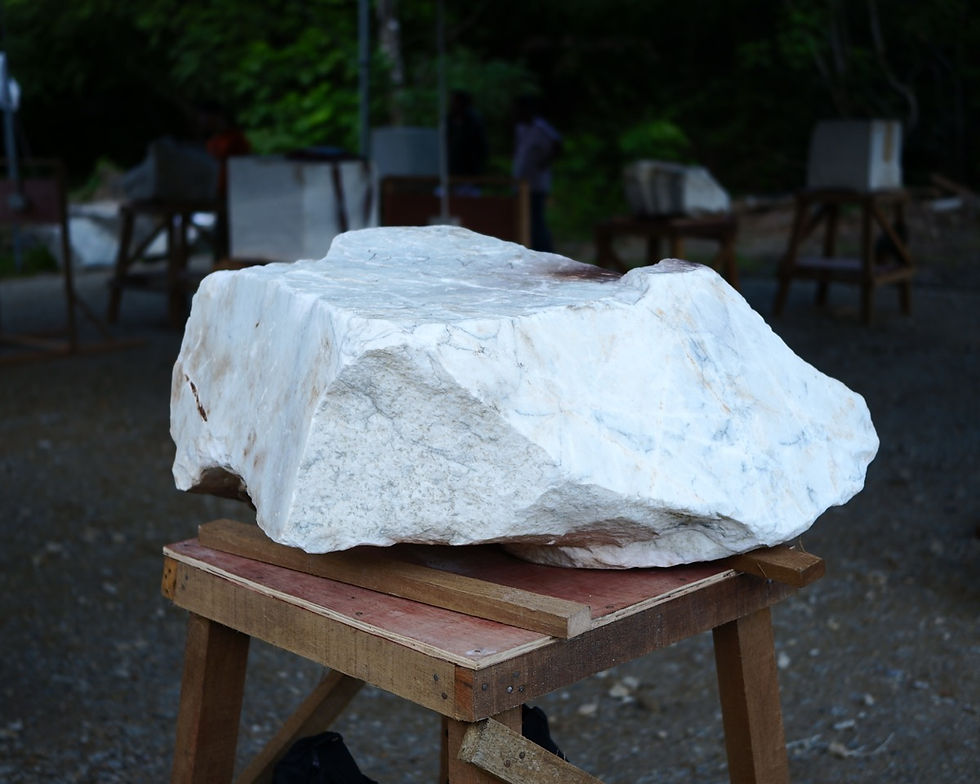
On the first day of production, not all of the marble blocks provided to the artists were uniformly cut. Only a few stones had been shaped into clean rectangular blocks. The stone assigned to me, however, was left in a rough, raw state, retaining its natural fractures and irregular contours. Its form differed greatly from my original sketch, forcing me to reconsider my plan at an early stage.
As I began to work with this stone, I gradually felt that its naturally formed shape should be respected and incorporated into the final work. Safety equipment—including masks, goggles, and gloves—was fully provided, and although this was my first time working seriously with marble, I cautiously began carving with a grinder and chisel.
The workspace was exposed to strong sunlight in the mornings, which made progress difficult. While working under these conditions, I received advice and support from an artist working nearby, and through this exchange, I slowly became more comfortable with both the material and the tools.


Discovering the Form
On the following day, I flattened the bottom surface of the stone and then turned it over to work on the upper surface. The piece weighed nearly 100 kilograms, and turning it required the effort of four people. Although the task seemed risky, we managed it safely. Once the stone was flipped, I noticed a valley-like depression in its center. This concave form strongly resembled a natural mountain landscape, and I found it visually compelling.
From that moment, my focus shifted to how this feature could be preserved while refining the overall form of the sculpture. Rather than eliminating irregularities, I began to think about how the stone’s existing character could be emphasized.
As the surface work progressed and the form gradually emerged, I began to feel as though I was in dialogue with the stone itself. This sensation led me to title the work Dialogue.
Refinement and Finishing
I turned the stone over once again to refine the base, and after doing so twice, I decided to avoid any further rotations. From that point on, I worked carefully but efficiently to finalize the surfaces. Compared to iron, marble allows for relatively smooth and direct surface refinement, and I found the process of grinding and shaping the planes both engaging and rewarding.
The skills I had learned in university sculpture classes—particularly the importance of a stable base—proved essential at this stage. I gradually progressed through finer abrasives, finishing the surface with 1000-grit sandpaper. The contrast between the white and dark areas of the marble became increasingly vivid, and the balance between the natural, untouched areas and the refined surfaces felt well resolved.
This process brought back the same excitement and sense of fulfillment I had previously experienced when working with iron. I felt strongly that this was a direction I would like to continue exploring in my future practice. After signing the work, I considered it complete and felt confident in the result.


Exchange and Shared Experiences
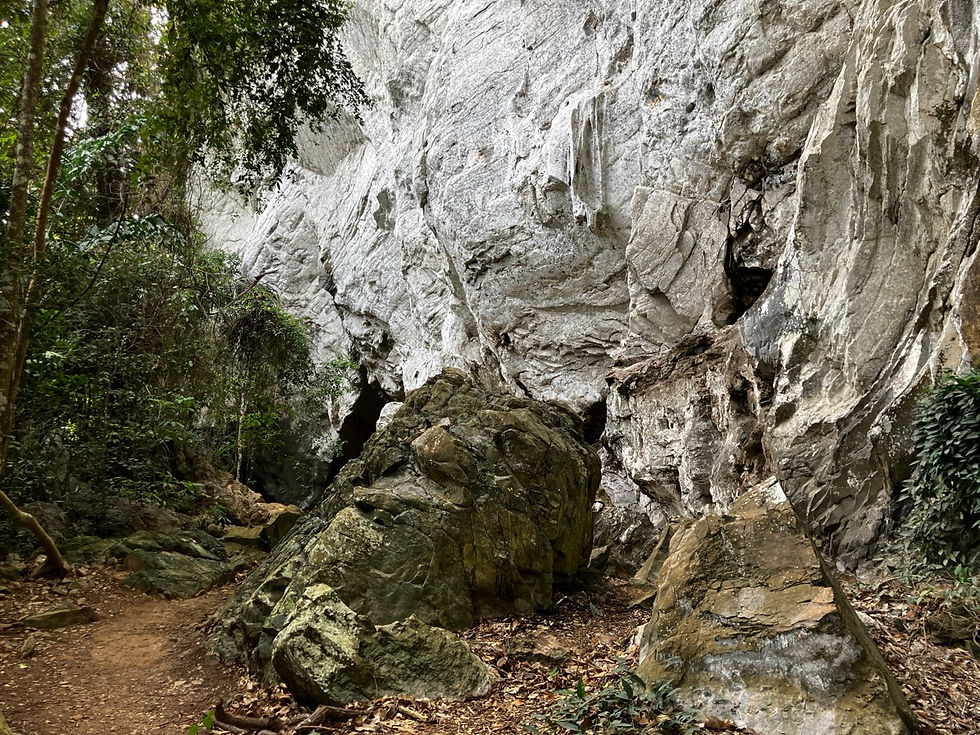
After the completion of the artworks, the program included time for relaxation and cultural exchange. One day was dedicated to sightseeing, including island hopping by boat. The silhouettes of the islands and mountains viewed from the water, as well as the experience of exploring caves, left a strong impression. The scale and vitality of the local vegetation were overwhelming.
In the evenings, spontaneous gatherings among the artists took place. On one occasion, fourteen artists gathered in a hotel room to present their own works and artistic practices. Each artist spoke about their daily work and conceptual approach in English. This session became an invaluable opportunity to practice presenting my work in an international context and to deepen mutual understanding. More than anything, the atmosphere of trust and openness that emerged among the participants was deeply meaningful. I felt genuine respect for each of the artists and was grateful to be part of such a group.


Exhibition and Opening Ceremony
The opening ceremony was held in the evening at the museum, where the completed works were displayed indoors and a large tent was set up outside for dining and socializing. While I was somewhat dissatisfied with the placement of my work—positioned toward the back corner of the exhibition space—I also recognized that this was unavoidable in a group exhibition of eighteen artists.
That said, I felt that more consideration could have been given to lighting and overall exhibition design. The opening itself was a grand event, attended by curators and distinguished guests from Kuala Lumpur. During the VIP viewing, I had the opportunity to present my work directly.
I explained that Dialogue was created through an ongoing conversation with the marble—deciding which parts of the stone to preserve and which to refine. Compared to many other works in the exhibition, my sculpture retained much of the stone’s original mass and emphasized its weight and presence. The refined surfaces were shaped to feel smooth and natural to the touch, without any sense of discomfort, allowing the viewer to engage physically with the material in a calm and intuitive way.
Many artists from other countries approached their work by carving a preconceived image out of the stone. In contrast, my approach was to harmonize human intervention with the stone’s existing natural form, ensuring that my actions did not overpower the material itself. Recognizing this difference objectively was one of the most significant discoveries of the camp.
Interestingly, the two other Japanese artists also produced works that made strong use of natural stone forms. I felt that this sensitivity to material may reflect a distinctly Japanese aesthetic. How this sensibility can be developed as a strength within an international context is a question that has become increasingly clear to me through this experience.


Proglam: Langkawi International Marble Art Camp
Date: 19 December until 28 December 2025
Period: 10 days, 9 nights
Organized by National Visual Arts Development Board, Malaysia
Coordinated by National Art Gallery Langkawi, Kedah, Malaysia
Supported by Ministry of Tourism, Arts and Culture of Malaysia

The National Art Gallery Langkawi will be organising the “Langkawi International Marble Art Camp (LAIN MACAM) 2025”, an International Sculpture Art Camp. The programme highlights marble as both a natural resource and an artistic medium, bringing together artists to explore, shape and transform Langkawi marble into contemporary sculptural works.
LAIN MACAM 2025 features the participation of 18 artists from 9 countries, comprising Malaysia, Thailand, Singapore, Indonesia, China, Japan, India, Nepal and Jordan.
The programme will take place at Gunung Raya Art Space (GRAS) from 19th to 28th December 2025.


Comments