
What is a work of art? | Exploring the nature of art from the perspectives of philosophy and Buddhism

Introduction
I sometimes feel a sense of unease with the terms "fine arts" and "art" as they are commonly used. It's not that I dislike fine arts. On the contrary, I've been helped by them in some ways, and I continue to create my own work even now. For me, creating art is very close to my way of life.
Even so, I sometimes feel a disconnect between explaining a work through its concept, connecting it to the context of art history and criticism, and treating nature as an object of observation from a human perspective, and my own bodily sensations.
Take "nature," for example. For me, nature is not something external to me. Mountains, rivers, stones, and light are not things I merely look at; they enter my body, blend with my memories, and change over time.
The feeling that something resides in a stone. The feeling that there is a presence in a place. The feeling that nature and humans are not clearly separate but are interconnected.
I've come to think that this sensibility is closer to a Shinto view of nature or to the Mahayana Buddhist concepts of "emptiness" and "dependent origination" than to the framework of modern Western art.
In this article, I would like to briefly trace the history of Western philosophy, consider phenomenology as a bridge between them, and ultimately explore my own understanding of art, drawing on Mahayana Buddhism and Shinto views of nature.
What emerges from this is a way of approaching art that views works not as "objects," but as "relationships."
1. The flow of philosophy and worldviews
When we think about art, we cannot avoid the fundamental question of how we perceive the world.
Looking at the broad history of Western philosophy, we can see changes from ancient times to the Middle Ages, the modern era, and the contemporary era.
The ancient Greek philosopher Plato (c. 427 BC – c. 347 BC) believed that behind visible reality lies a perfect and ideal "Idea." He thought that while the real world is constantly changing and imperfect, there is an unchanging essence behind it.


In the Middle Ages, the world came to be understood within the Christian order of God. In the philosophy represented by Augustine (354–430), nature, humanity, and the universe were all created and ordered by God.


Then, in the modern era, a major shift occurred with Descartes (1596-1650). Descartes started with the concept of the "thinking self." Here, humans become subjects that observe and analyze the world. On the other hand, nature is positioned as the object to be observed.


To summarize broadly, it is as follows:
Ancient times: The essence behind the world was conceived.
Middle Ages: The world was conceived as one ordered by God.
Modern era: Humans began to observe and analyze the world.
This modern way of thinking has underpinned much of modern society, including science, medicine, industry, transportation, and communication. By quantifying, analyzing, and managing nature, humanity has achieved great progress.
However, at the same time, there are things here that are easily overlooked.
Experiences felt with the body. Lights that linger in memory. A presence that permeates a place. Sensations that remain when touching stones, wood, or water.
If we view nature too much as "something outside of humanity," these kinds of feelings become difficult to see. Some of the unease I've felt towards art may be related to this modern way of looking at the world.
2. Language and Embodiment in Contemporary Art
Contemporary art is not unrelated to this modern way of thinking.
Artwork is evaluated within museums, galleries, criticism, the market, and art history. In these contexts, the work's context, its concepts, and its relationship to society and history are all considered.
For example, the following values are highly valued:
Art historical value
Academic value
Social value
Market value
Strength of the concept
criticality
Relationship with the exhibition space
Reference work: Joseph Kosuth, "One and Three Chairs," 1965. This work juxtaposes an actual chair, a photograph of a chair, and a definition of the word "chair," symbolically illustrating the relationship between "object, image, and word" in contemporary art.
Of course, these are very important. In order to share, critique, and preserve works of art within society, we need words and context.
However, when the words used to describe a work are too polished, it can sometimes obscure the fundamental feeling behind the creation of that work.
Works that deal with nature are often described using terms such as "environment," "regionality," "sustainability," "materiality," and "place." These terms are valid, and I myself sometimes use them.
However, for writers, nature is not always something that can be categorized as a social theme.
The sunlight filtering through the trees that I saw when I was little.
The coldness of the water when playing in the river.
The moment the light I saw while traveling overlapped with old memories.
When you touch a stone, you get the feeling that something remains inside your body.
These experiences cannot be fully explained by objective words alone.
The foundation of my work isn't a clear concept from the start. Rather, it begins with the natural sensations that remain in my body, and the atmosphere that arises when I touch a place.
Words are necessary. However, if words obscure the feeling that forms the starting point of a work, then we need to reconsider how we use them.
Phenomenology is a crucial clue for me in this regard.
3. Phenomenology: Connecting Philosophy and Buddhism
Edmund Husserl (1859-1938), the founder of phenomenology, questioned not only how the world objectively exists, but also how the world appears to us.

For example, let's say there's a stone in front of you.
From a scientific standpoint, it's just a rock. It has weight, shape, and composition.
However, if that stone evokes memories of the riverbank where one played in childhood, it ceases to be just a stone. If someone views it as an object of prayer, the stone becomes associated with faith. If it is exhibited as a work of art, it begins to connect with the memories and bodily sensations of the viewer.
At this point, the stone appears not merely as a material object, but as a meaningful entity.
The world doesn't simply exist; it manifests itself to us in relation to our bodies, memories, emotions, places, and time.
Although this way of thinking originated in Western philosophy, it has the power to re-examine modern objectivism and the view that separates mind and body.
This perspective also overlaps in some ways with the Buddhist worldview.
In other words, phenomenology, while originating from within Western philosophy, can be seen as a bridge to the Buddhist sensibility of understanding the world in terms of "relationships."

4. "Emptiness" and "Dependent Origination" in Mahayana Buddhism
In Mahayana Buddhism, Nagarjuna (circa 150-250 AD) further developed the concept of "emptiness" (sunyata).

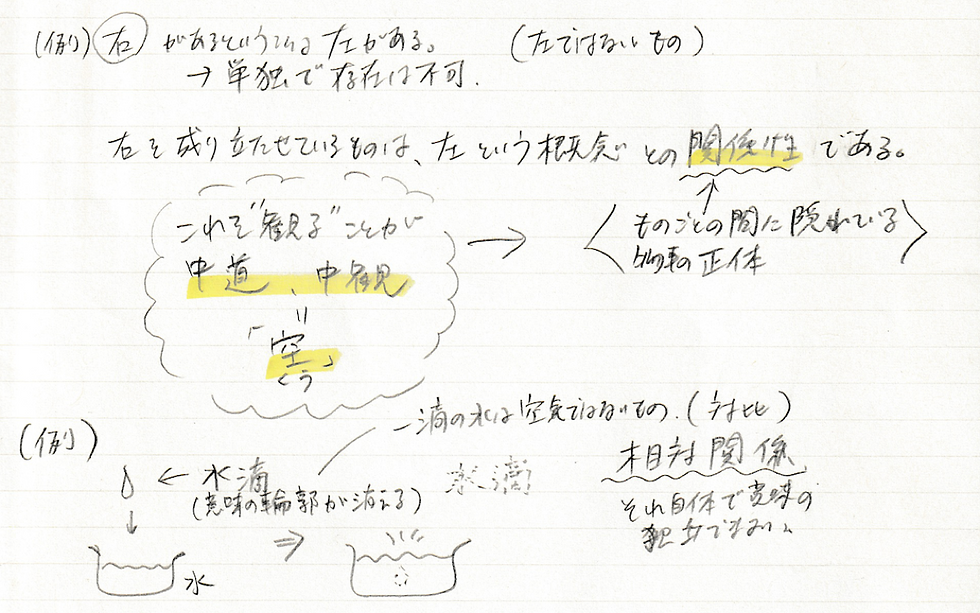
"Emptiness" doesn't mean that nothing exists. It means that nothing has a fixed essence.
And "auspiciousness" is the idea that nothing exists in isolation, but rather is made up of various relationships.
Things do not have a fixed essence.
Everything is based on relationships.
Humans and nature do not exist completely separately.
Meaning is born within relationships.
The world is constantly changing.
This way of thinking is quite different from the modern model of "humans viewing nature."
In modern thinking, humans observe nature. In phenomenology, nature is experienced through the body and consciousness. In Mahayana Buddhism, both humans and nature exist in a relationship with one another.
When I put these three things together, my thoughts about my work become a little clearer.
A work of art, too, does not exist in isolation as a finished "thing." Rather, it is something that arises in each instance within the context of its relationship with materials, place, memory, body, time, and the audience.
5. Think of the artwork not as an "object" but as a "relationship."
Applying Mahayana Buddhist concepts like "emptiness" and "dependent origination" to art can change how you view works of art.
A work of art is not a finished object. A work of art is made up of various interconnected elements.
A single work of art involves many elements, including materials, location, memory, bodily sensations, the act of creation, light, time, exhibition space, audience, and social context.
The artwork comes to life when these elements come together.
In other words, I think a work of art is not a "thing," but rather a knot of "relationships."
Art is not merely an expression of the artist's inner world. Nor is it solely an explanation of a social message.
For me, art is the act of transforming personal experiences into a form that others can touch.
It's about giving form to the sensations remaining in one's own body, in relation to materials and place. It's about placing that in an exhibition space and connecting it with the viewer's experience. And from that, new meaning emerges.
The meaning of a work of art is not determined solely by the artist. It constantly changes within the context of the materials, location, time, and relationship with the audience.

6. The Value of the Work
Financial value, academic value, semantic value
Now, I'd like to consider the value of the artwork as well.
In the world of contemporary art, the value of a work is often discussed in terms of its external context.
What significance does this hold in art history?
How does it connect to a critical context?
How do you address social themes?
What price will it have in the market?
What is its exhibition and collection history?
These are essential elements for a work of art to be appreciated, shared, and endure within society.
On the other hand, I feel that the value derived from the artist's own perception and physical sensations tends to be relegated to a lower position.
I'd like to call it "meaningful value."
Semantic value is the value that arises from personal memories, relationships with places, beliefs and prayers, physical sensations, audience experiences, and memories of a region or community.
This is something that is difficult to quantify. It cannot be clearly represented like market prices. Nor can it be fully explained through academic papers or critical writing alone.
However, for an artist like myself, who creates based on subjective feelings, memories, experiences, and spirituality, this very meaning and value are at the heart of the work.
The value of a work of art can be broadly categorized into three areas.
"Financial value": Price of the artwork, sales performance, collection value, and value as an investment.
"Academic value": Relationship with art history, ideological background, uniqueness of techniques and materials, critical context, potential as a subject of research.
"Meaningful Value": Value that arises from the artist's perception, bodily sensations, memories, relationship with the place, and the audience's experience.
These three things do not exist separately.
The value of a work of art doesn't begin as a monetary value. At its core lies how the artist perceives the world. This perception connects with materials and locations, giving rise to the work itself. And as the work reaches others, personal experiences transform into shared meaning.
Its meaning, intertwined with the audience's experiences and social context, expands to encompass meanings for the community, society, and even the future. This is where the meaningful value of the work emerges.
The value of a work of art is thought to expand in the following ways:
Author's perception
↓
personal meaning
↓
Meaning shared with others
↓
Meaning for community, society, and the future
↓
Meaning and Value
↓
Academic value
↓
Financial value
As this meaningful value deepens, is articulated, and becomes the subject of criticism and research, it leads to academic value. And I believe it also connects to financial value through exhibitions, collections, and market evaluations.
What's important here isn't to deny the financial or academic value of the work. Rather, it's about deepening the inherent value of the starting point of the work, which will then lead to those other values as well.
A work of art is not a "thing," but a "relationship."
If we consider this, then the value of a work of art does not reside in a single object. Rather, it is born from the artist's perception, materials, place, body, audience, community, society, and the future.
7. About my work
Rather than recreating nature, we materialize experience.
My work is not about reproducing nature as an objective subject.
I don't just see nature as an "outside landscape," but rather as something that enters my body and memory, and changes over time.
For me, having grown up in the mountains of Kyushu, the scenery of fresh greenery, the sunlight filtering through the trees on mountain paths, the sparkle of the river, and the feel of the stones on the riverbed are not merely landscapes. They are experiences that remain within me.
The light and atmosphere of places encountered during travels overlap with childhood memories and eventually transform into "the nature within oneself."

For example, in the "Shakoseki" (Light-Responding Stone) series, light recorded in photographs is printed onto Japanese paper and then attached to natural stones. What is important in this work is not just the stone as a material. The work comes into being through the interaction of the photograph, the light, the location where it was taken, the memory, the body touching the stone, the exhibition space, and the viewer's experience.

In the "Stone Garden" series, natural landscapes and lingering physical sensations are translated into space using iron wires. Rather than simply reproducing natural forms, the series reconstructs the natural structures and atmospheres felt through the body, within the context of the iron material.

For me, a work of art is not a finished physical object. It is a space where meaning emerges each time through the interaction of materials, place, body, memory, and the audience.
In that sense, my work is not a reproduction of nature, but the materialization of experience.
For me, creating art means re-establishing the nature that has changed and transformed within me, within the context of its relationship with materials and space.
In conclusion
Towards art as a relationship
Western philosophy has developed methods for understanding, analyzing, and articulating the world through reason. This trend has had a significant impact not only on modern science but also on the institutions and criticism of contemporary art.
Of course, there's no need to deny that. In order to share, critique, and place a work within society and history, language and theory are necessary.
However, there are aspects of art that cannot be fully captured by that alone.
For writers who grew up within the cultural and religious sensibilities of Japan, particularly those influenced by Buddhism and Shintoism, nature and material things are not merely objects of observation.
Stones, trees, light, water, and places possess an atmosphere that goes beyond their visible form and function. Humans are not merely subjects who unilaterally observe nature, but rather beings who live in relation to nature and places.
I believe this feeling cannot be fully captured within the framework of "seeing subject" and "seeing object" found in modern Western philosophy. Rather, it resonates deeply with Mahayana Buddhist concepts such as "emptiness" and "dependent origination," as well as the Shinto view of nature.
In modern society, everything is quantified, managed, and commodified. In this context, I feel that there is great significance in the way art is viewed not as a standalone object, but as something that is understood within the context of relationships.
A work of art is not a "thing," but a "relationship."
For me, creating art is not about recreating nature. It's about bringing back to life the nature that has changed and transformed within me, in relation to the materials and the place.
What if the value of a work of art doesn't lie in the finished object itself, but rather in the artist's perception, materials, location, memories, and relationship with the audience?
Perhaps art can be re-evaluated as something much broader.
I believe it's an act of re-examining the relationships that arise between nature and humanity, between things and memories, between artists and audiences, and between individuals and society.
References:
Coten Radio, a fun way to learn history, presents "Crew Bonus #105 : Post-Capitalism Survey - Regular Meeting Video (Held on February 12, 2026)," to be released on May 26, 2026. https://www.cotencrew.com/bonuses/105

Comments